
Worked case: a 3,000-square-foot warehouse floor on the Jefferson-Madison corridor, cracks repaired, joints filled and aisles striped — what happens and what it costs
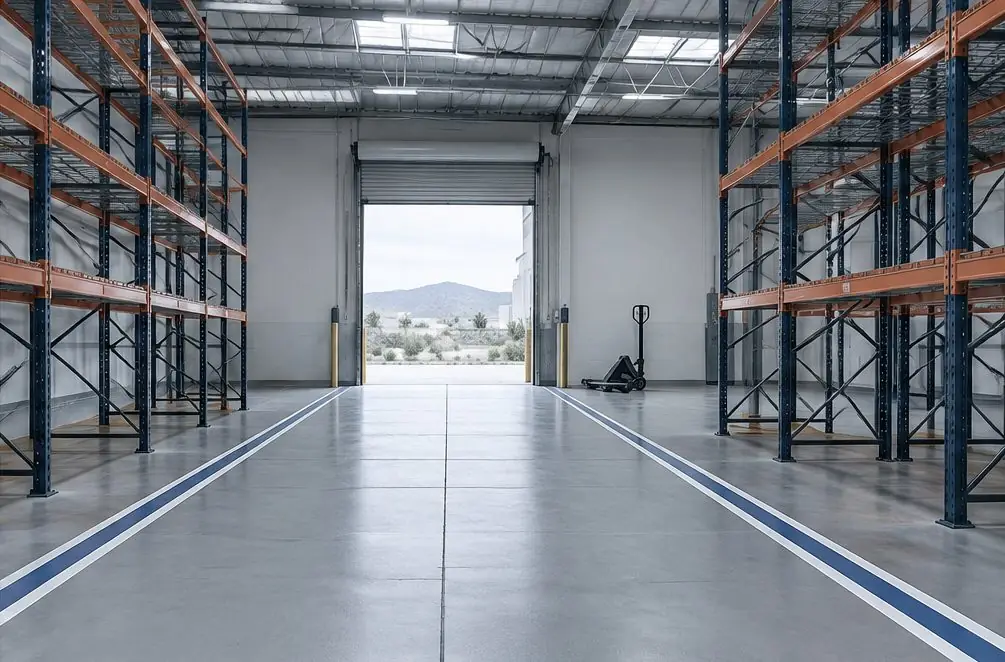
Epoxy Floors Ridge Murrieta walks through a typical job for a 3,000-square-foot warehouse unit in a business park on the Jefferson-Madison corridor: a slab-on-grade floor with saw-cut joints and cracks near the dock door, solid-color epoxy with grit, joints filled, aisles striped and the work scheduled after hours.
Bookings aren't open yet. Leave your name and number; your message is recorded, and you'll get one message when a local installer is available.
Worked example. The pictures are AI concept illustrations, not photographs; no installation was performed or arranged through this site; prices are typical Murrieta area market ranges, not quotes.
 Illustration
Project Examples & Typical Prices
The scenario
Picture a single-story unit in a business park on the Jefferson-Madison corridor. The tenant uses it for storage and shipping: a small front office, a warehouse floor of about 3,000 square feet and a roll-up dock door on the back wall. The floor is a slab-on-grade cut with control joints about every dozen feet. Pallet jacks and one electric stacker are the heaviest things that touch it.
The concrete dusts when swept, several saw-cut edges have chipped where the pallet jack wheels cross them, and a few cracks run from the corners of the racking. The tenant wants a floor that sweeps clean, takes aisle striping and does not shed dust onto the stock. The lease says the landlord must agree to changes, and the tenant obtains that consent.
The starting conditions at a glance:
- Size: about 3,000 square feet of slab
- Slab: slab-on-grade with saw-cut control joints, chipped edges, cracks near the racking, dusty surface
- System: solid-color epoxy with grit in the top coat
- Schedule: after hours and weekends, so the dock door can open on weekdays
What the job involves
- The tenant and installer draw a zone plan that numbers the aisles and keeps the dock lane open on weekdays; the tenant moves its own stock from one zone to the next.
- A planetary grinder with an industrial vacuum takes the dusty surface off one zone at a time, and an edge grinder works the walls and racking bases; a moisture reading is taken in the first zone.
- Cracks are routed and filled, and chipped joint edges are rebuilt with a repair mortar.
- The saw cuts are blown clean and filled with a semi-rigid joint material, so the slab can move without cracking the coating.
- A primer and a pigmented 100%-solids epoxy are rolled in strips, and the coating is cut along each joint; a clear top coat with grit goes over it for texture under wheels.
- After the cure time on the data sheet, a chalk line lays out the aisles and walkways, the stripes are painted or taped and the stock returns to the zone.
Materials and prep
- Planetary floor grinder, wall-edge grinder and a high-capacity dust extractor
- Semi-rigid joint filler and a patching mortar for spalled saw-cut edges
- Primer, pigmented 100%-solids epoxy and a gritted clear finish coat
- Squeegees with notched blades, roller frames, cleated shoes and ventilation fans
- Tape or line paint, a chalk reel and a measuring wheel for the aisle layout
What it typically costs in the Murrieta area
| Solid-color epoxy with grit, 3,000 square feet installed ($4–$8 per sq ft) | $12,000–$24,000 |
| Cracks, joints or spalls to repair (+$1–$3 per sq ft) | +$3,000–$9,000 |
| Line striping and safety markings | +$300–$1,000 |
| Joint filling (saw cuts and control joints) | +$400–$1,200 |
| Typical total | $15,700–$35,200 (market range, not a quote) |
These are typical local ranges, not a quote or an offer; an installer prices the actual job after seeing the floor.
Add-ons often paired with this job
- Cove base up to 100 linear feet — +$1,500–$2,500. A coved base can be added along the walls of the office zone.
Why it is done this way
Gritted solid-color epoxy matches aisles that see pallet jacks and a light stacker: it seals the dust, accepts striping and sits at the low end of the commercial systems, $4–$8 per square foot. Where hard-wheeled lift trucks keep pivoting on one spot, quartz broadcast at $8–$15 deserves a look.
The repair line weighs heavily on a floor this size. At $1–$3 per square foot, 3,000 square feet carries $3,000–$9,000 for repairs, so a site walk that counts cracks and chipped edges is what first moves the quote. The estimator adds the repair line to the base before multiplying, which gives a combined $5–$11 per square foot.
Joint work decides how many seasons the floor keeps looking good. Rigid coatings bridge saw cuts poorly, so each cut is cleaned, filled with flexible material and the coating is cut above it. Where this step is skipped, a line of cracks tends to appear right over the saw cut.
The after-hours schedule is what keeps the business running: working zone by zone on evenings and weekends leaves the dock usable on weekdays. In the estimator, schedule is a note for the contractor and does not change the range. Return to foot, cart and forklift traffic depends on the system, temperature and humidity, so the data sheet decides.
The city reports industrial vacancy of 3% and more than 2 million square feet of business park space in operation, which is the kind of building that changes tenants; a floor that takes striping and cleans easily is one a landlord can accept.
The alternatives that were weighed and set aside:
- Polished concrete densifies and hardens the slab and controls dust, but it handles oil less well and does not carry striping the same way.
- A penetrating sealer costs less and wears faster under wheels.
What would change the price
- Leaking pallets or a damp reading bring in the oil and moisture line of $2–$5 per square foot.
- An existing coating or leftover adhesive has to come off before this range applies.
- If hard-wheeled lift trucks keep pivoting at the same spots, quartz broadcast becomes the better fit.
- Saw cuts spaced closer than the plan assumed add filling time.
- Racks that cannot be emptied or shifted stretch the schedule.
Where this leads
- Service page: Warehouse Floor Coating — Aisle, apron and joint planning for warehouse and light-industrial floors, with a hot-door section and a two-zone sample budget.
- Local page: Epoxy garage floors in Jefferson-Madison corridor
- All services and typical prices: epoxy garage floors in Murrieta
- More worked examples: Project Examples & Typical Prices
Check availability and the price range for this setup
Bookings aren't open yet — a typical Murrieta range in about 30 seconds.