
Retail and Showroom Epoxy Floor in Murrieta
Epoxy Floors Ridge Murrieta covers decorative epoxy floors for stores, salons and showrooms in Murrieta — suites along Winchester Road, Old Town storefronts on Jefferson Avenue and larger showroom units in the business parks — with finishes chosen for scuffs, glare and the hours the doors are open.
Bookings aren't open yet. Leave your name and number; your message is recorded, and you'll get one message when a local installer is available.
 Illustration
What a sales floor has to put up with
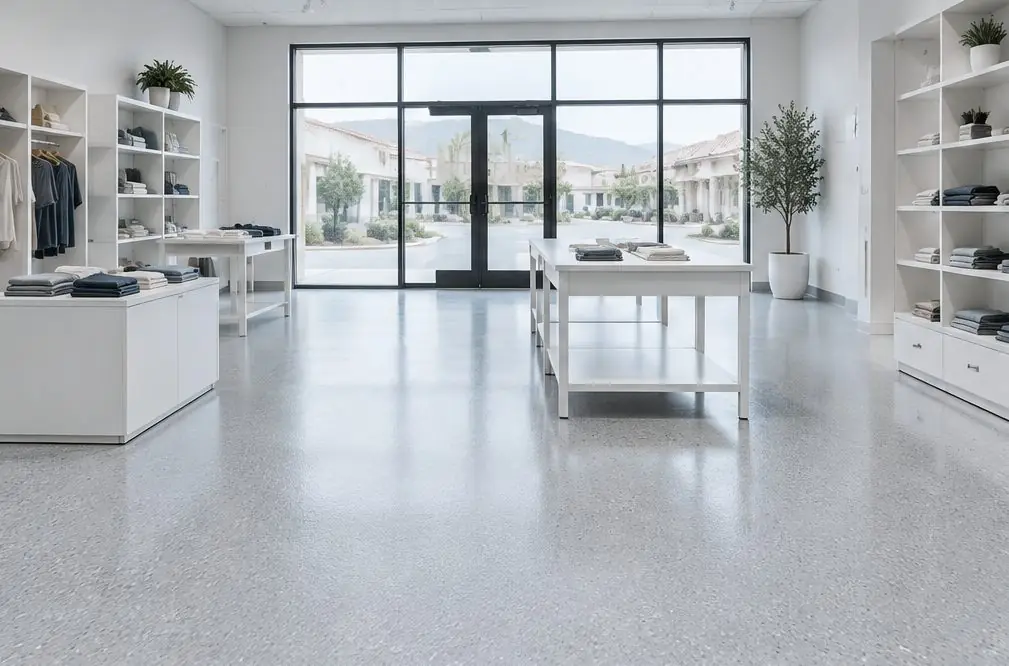
Shoppers look at the floor first and linger on it second. Daylight through front glass shows scuffs and swirl marks that disappear indoors, and carts, strollers and rolling racks add their own. The finish is chosen for the wear it will show as much as for color.
| Finish | Look | Where it tends to fit | Estimator range per sq ft |
|---|---|---|---|
| Solid color, satin top coat | Plain, clean | Stockroom, back of house | $4–$8 |
| Decorative flake | Speckled, forgiving | Sales floor, salon, lobby | $6–$12 |
| Quartz-filled broadcast | Textured, wear-resistant | Entry strip, busy aisle | $8–$15 |
Storefront glare and sheen
Gloss deepens color and shows every scratch, and a bright Murrieta afternoon through west glass bounces glare across a high-gloss floor. A satin or semi-gloss top coat softens reflections and hides scuffs. View samples in the store at the hours it is busiest, since daylight and fluorescent light shift color differently.
The last tenant's floor
Retail suites often arrive with tile, carpet or sheet flooring from a previous tenant, and the slab underneath holds adhesive. Old mastic and some older tile can contain asbestos, so an older building gets a test before anything is ground or scraped. Where the slab is sound and clean, flake or quartz goes onto a ground surface. In a multi-tenant strip, the landlord's rules on noise, dust, work hours and shared loading areas are part of the plan, and the landlord decides what applies.
Coating around opening hours
Stores seldom close for long. One approach coats the sales floor in two halves after closing, with the entry route kept clear for the next day. Another uses a weekend with the stockroom done first. Commercial installs are often scheduled after hours, on weekends or in phases, so part of the floor stays in use. Return to foot traffic, carts and fixtures depends on the system, temperature and humidity and is set by the data sheet; odor and ventilation matter in a shared strip where the air handler may be shared too.
A 1,200-square-foot suite with an entry strip
A hypothetical suite has 1,200 square feet of decorative flake at $6–$12 per square foot, $7,200–$14,400, and a 250-square-foot quartz entry zone at $8–$15 per square foot, $2,000–$3,750. Together the floor costs $9,200–$18,150 on a sound slab.
| Zone (hypothetical) | Area | Rate per sq ft | Total |
|---|---|---|---|
| Sales floor, decorative flake | 1,200 sq ft | $6–$12 | $7,200–$14,400 |
| Entry strip, quartz broadcast | 250 sq ft | $8–$15 | $2,000–$3,750 |
| Whole suite | 1,450 sq ft | $9,200–$18,150 |
If the sales floor also needs an old coating removed (+$2–$5 per square foot), the flake zone becomes $8–$17, or $9,600–$20,400. Market estimates, not quotes.
Retail and Showroom Epoxy Floors — common questions
Which finish hides scuffs best in a store?
Flake and quartz systems hide scuffs better than a smooth single color, and a satin top coat hides them better than a gloss one.
Can a store be coated without closing for days?
Often, in sections after closing hours or over a weekend. The data sheet sets when foot traffic and carts return, and the schedule flag in the calculator tells a contractor what the store allows.
Retail and Showroom Epoxy Floors: check availability and price range
Bookings aren't open yet — a typical Murrieta range in about 30 seconds.