
Warehouse Floor Coating in Murrieta
Epoxy Floors Ridge Murrieta covers floor coatings for warehouses and light-industrial units in Murrieta — racking aisles, dock aprons, roll-up door thresholds and charging corners — in the business-park buildings of the Jefferson-Madison corridor and the industrial buildings of French Valley, with joints, striping and heat at the door planned before the system is named.
Bookings aren't open yet. Leave your name and number; your message is recorded, and you'll get one message when a local installer is available.
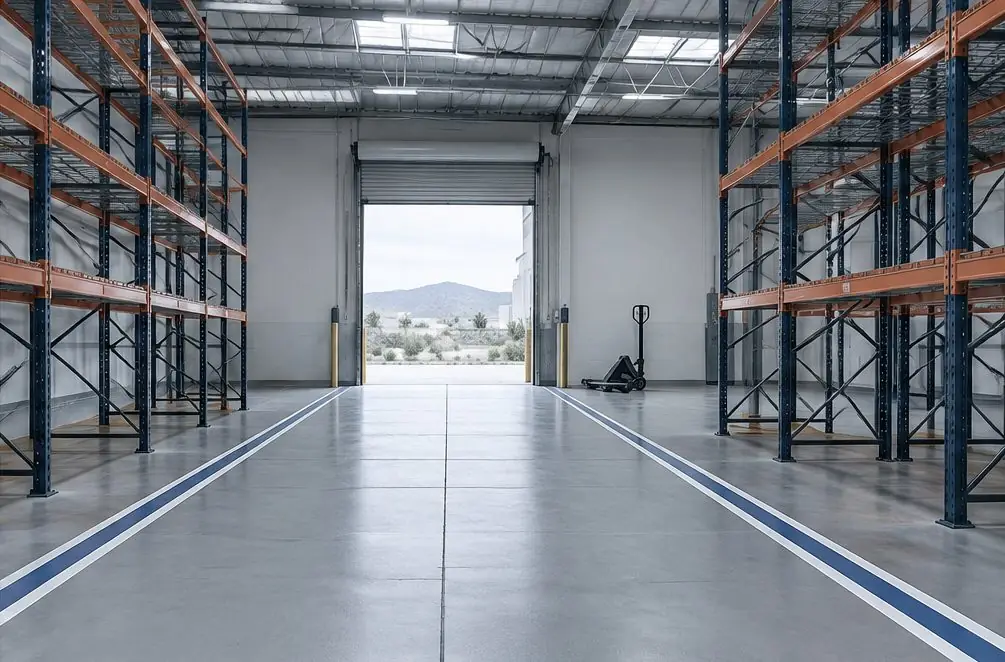 Illustration
Aisle, lane and apron are three different floors
Raw concrete sheds dust onto stock and soaks up oil from a leaking jack. A coating seals the surface, but the surface under a pallet jack differs from the one at a dock door.
| Zone | Loads | System usually considered | Estimator range per sq ft |
|---|---|---|---|
| Racking aisle | Pallet jacks, steady loads | Solid-color epoxy with grit | $4–$8 |
| Forklift lane | Hard wheels turning and braking | Quartz-filled broadcast | $8–$15 |
| Dock apron and roll-up door | Impact, tire marks, sun at the opening | Quartz broadcast or a heavier solid system | $8–$15 |
| Battery charging corner | Possible electrolyte spills | A system whose chemical-resistance chart is checked | Quoted per project |
| Packing bench and office | Foot traffic, rolling chairs | Decorative flake or solid with a satin top coat | $6–$12 |
Where the sun comes in
A door apron sees more than traffic. Low sun enters through the opening, and in Murrieta the average July and August afternoon high is 91°F, so a slab in the sun can sit well above the air temperature and trap bubbles under a fast-cure film. Contractors plan door zones for the cool morning, shade the opening where they can and check the data sheet's temperature range. Epoxy can amber in sunlight, so the door is also where a more UV-stable top coat is considered.
Ask how slab temperature is measured on the day, not only what the forecast says.
Saw cuts, construction joints and the cracks between
Warehouse slabs are cut so the concrete cracks where intended. A rigid film laid over a moving joint tends to crack above it, so saw cuts are cleaned and filled with a flexible filler and the coating stops at the joint. The estimator lists joint filling as a flat $400–$1,200.
| Joint | What it is | If ignored |
|---|---|---|
| Saw-cut control joint | A planned crack line | The coating cracks along the line |
| Construction joint | Where two pours meet | More movement; edges chip under wheels |
| Slab crack | An unplanned split | Moves, so it can show again after repair |
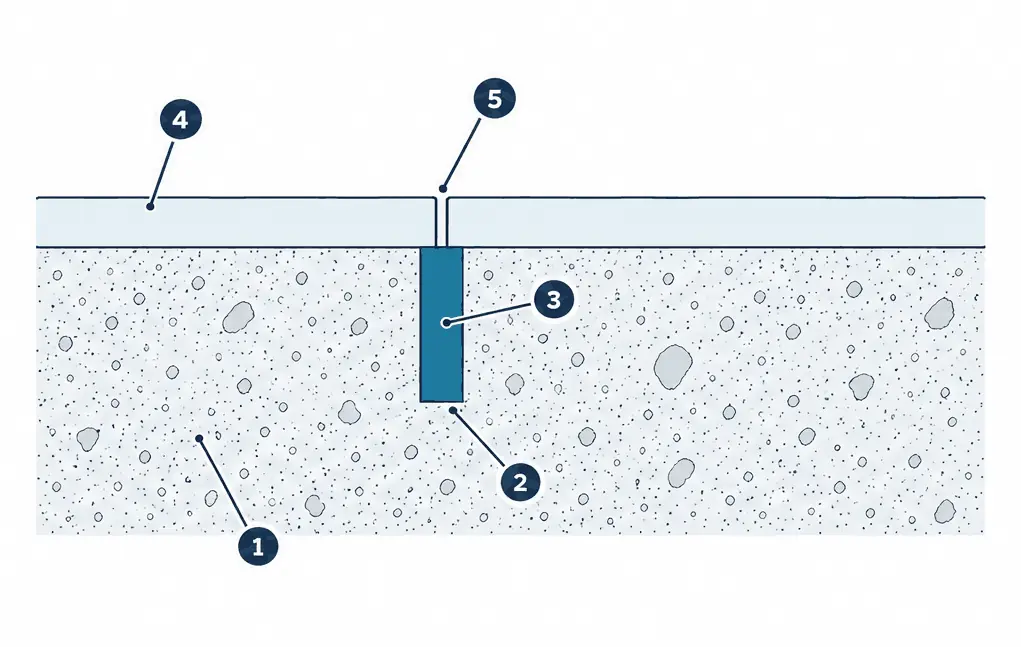
What the numbers show
- Concrete slab Slabs are cut with joints so that shrinkage cracks form in straight lines.
- Saw-cut joint The groove cut after the pour, roughly a quarter of the slab depth.
- Joint filler A flexible fill brought flush so wheels do not chip the edges.
- Coating Continuous on both sides of the joint.
- Cut in the coating A thin cut in the film right above the joint lets the slab move without tearing the coating.
A sample budget for two zones
A hypothetical 4,000-square-foot aisle area in solid epoxy with grit costs $16,000–$32,000 at $4–$8 per square foot, and filling the saw cuts adds $400–$1,200, so the zone lands at $16,400–$33,200. A separate 500-square-foot dock apron in quartz broadcast at $8–$15 per square foot comes to $4,000–$7,500.
| Zone (hypothetical) | Area | Calculation | Total |
|---|---|---|---|
| Aisles, solid epoxy with grit | 4,000 sq ft | $4–$8 per sq ft, plus joint filling $400–$1,200 | $16,400–$33,200 |
| Dock apron, quartz broadcast | 500 sq ft | $8–$15 per sq ft | $4,000–$7,500 |
Market estimates, not quotes. An oil-soaked slab (+$2–$5 per square foot) or an old coating to remove (+$2–$5) raises the aisle rate; on the 4,000-square-foot zone an oil surcharge turns $4–$8 into $6–$13, or $24,000–$52,000.
Lanes, lines and markings
Pedestrian lanes, forklift lanes and no-stock zones are marked with paint or striping tape, and a cured coating holds a line better than bare concrete. The layout is drawn before coating so the base color suits the marks: a pale base shows tire marks, a very dark one shows dust. Line striping is a flat option in the estimator at $300–$1,000.
Keeping deliveries moving
A warehouse that receives trucks rarely stops. A common plan coats one bay or aisle block at a time and marks on a drawing which lane stays open. Return to carts and forklifts follows the data sheet for the day's temperature, and the contractor learns the delivery pattern through the schedule flag.
Warehouse Floor Coating — common questions
Is polished concrete or epoxy better for a Murrieta warehouse?
They solve different problems. Polished concrete grinds and hardens the slab itself and has no film to peel; epoxy seals the surface against oil and is easy to recolor. Heavy oil and leaks favor epoxy, while a bare-concrete look with little fluid exposure favors polishing.
Can a forklift drive on a coated floor?
On systems designed for it, after the cure time on the data sheet. Thin garage-grade coatings are not built for hard forklift wheels.
Warehouse Floor Coating: check availability and price range
Bookings aren't open yet — a typical Murrieta range in about 30 seconds.