
Polyaspartic Garage Floor Coating in Murrieta
Epoxy Floors Ridge Murrieta covers polyaspartic and polyurea garage floor coatings in Murrieta — the quick-curing systems often sold as one-day floors — for driveways that face the afternoon sun, with the hybrid-versus-full choice, hot-day pot life and slab moisture explained ahead of the price.

Bookings aren't open yet. Leave your name and number; your message is recorded, and you'll get one message when a local installer is available.
 Illustration
Hybrid or full polyaspartic: what the bid means
Polyaspartic is one kind of polyurea, formulated for slightly more working time than a straight polyurea. In a bid the word can mean two builds with different prices and different demands.
| Question | Hybrid | Polyaspartic throughout |
|---|---|---|
| Layers | Epoxy primer and base carry the chips; a polyaspartic top coat seals them | Polyaspartic primer, base and top coat |
| Working time | Longer, set by the epoxy | Shortest; the crew mixes small batches |
| Slab tolerance | Moderate | Least forgiving of damp or poorly ground concrete |
| Estimator band | $7–$11 per sq ft (polyaspartic flake) | Quoted per project |
Ask which build the bid prices. The estimator's polyaspartic flake band assumes an epoxy base with a polyaspartic top coat.
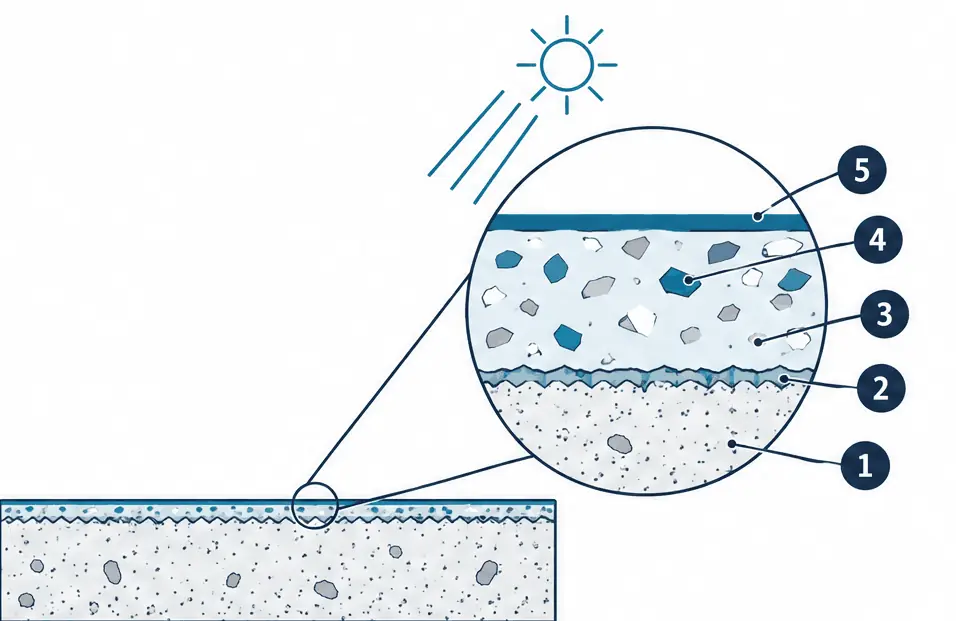
What the numbers show
- Concrete slab The base for every layer above it.
- Ground surface Grinding opens the slab so the first coat can key into it.
- Primer and epoxy base Together they carry the bond and hold the flakes.
- Flake Chips sit in the base, with their tips showing through.
- Polyaspartic top coat A thin, glossy film that is generally more UV-stable than epoxy and is mixed in small batches because it sets fast.
Pot life when the apron is hot
Polyaspartic sets fast, and heat shortens it further. With July and August highs averaging 91°F and a driveway slab hotter than the air, a mix that is relaxed at 7 a.m. becomes a race by late morning. Installers typically mix small batches, roll quickly, broadcast at once and start in the cool hours.
Ask when the work starts, how the slab temperature is read and how much is mixed at a time. A crew that pours a large batch on a warm slab risks lap marks, bubbles and a rushed broadcast.
Return to use, step by step
Many polyaspartic systems can be installed in one day. That describes the install, not the finish line. The sequence below is typical; the product's data sheet gives the real times for that day's temperature and humidity.
| Stage | Typical pattern |
|---|---|
| Install day | Primer, base, chips and top coat, often within one long day for a two-car garage |
| Next day | Foot traffic usually returns in clean, soft-soled shoes |
| First days | Shelving and light items return after the data sheet's light-use time |
| Vehicles | After the data sheet's time, often 24 hours to several days depending on product, temperature and humidity |
| First weeks | Cleaners, oils and brake fluid wait for the sheet's full chemical-cure time |
Get the date a car may return in writing and keep vehicles in the street until then.
A new slab does not give vapor much time
A fast-curing film leaves little room for moisture to escape. A tract slab can be past 28 days and still give off vapor; manufacturers commonly advise at least 28 days and up to 60 in some conditions, and in-slab humidity probes are described as the most accurate reading. The system being installed sets the limit.
A polyaspartic top coat over a damp slab can blister or cloud. Where readings are high, a moisture-mitigating primer is used or the job waits. With the optional primer the estimator adds $400–$1,000, so a 400-square-foot polyaspartic flake floor lands at $3,200–$5,400 instead of $2,800–$4,400.
Sun at the door and tires on the pad
Epoxy can amber in sunlight, most visible where a garage door faces west and stays up through summer afternoons. Polyaspartic top coats are generally more UV-stable, which is the usual reason to choose one in Murrieta. Hot-tire pickup, a warm tire lifting the coating, is mostly a prep and product problem; a ground slab and a system rated for it reduce the risk.
Some systems smell strongly during the cure, so the door stays open and people and pets keep out until the data sheet says otherwise. Coatings sold and applied in California must meet the local air district's VOC limits for floor coatings, so the products differ from some sold elsewhere.
Polyaspartic flake prices by garage size
Typical Murrieta prices for a polyaspartic flake floor on a sound slab, from the estimator ($7–$11 per sq ft installed):
| Garage size | Area | Typical total |
|---|---|---|
| 1-car | 240 sq ft | $1,680–$2,640 |
| 2-car | 400 sq ft | $2,800–$4,400 |
| 3-car | 700 sq ft | $4,900–$7,700 |
| 4-car | 900 sq ft | $6,300–$9,900 |
Against full-broadcast epoxy flake that is about $1–$2 more per square foot, $400–$800 on a two-car garage. Cracks, an old coating or a damp slab add to either system. Market estimates, not quotes.
What the paperwork should say about coverage
Warranty terms are set by the installer and by the coating manufacturer. Because polyaspartic is sold on speed and sun behavior, these are the lines to read before signing.
| Line | What to ask |
|---|---|
| What is covered | Peeling, hot-tire pickup and UV yellowing, each named or excluded |
| For how long | A stated period, and from which date |
| What it excludes | Moisture, new cracks and damage from the owner's use are common exclusions |
| The prep | Whether grinding and the moisture test are part of what is covered |
| Who stands behind it | The installer, the manufacturer, or both, named on the paper |
Polyaspartic Garage Floor — common questions
Is polyaspartic worth the extra cost in Murrieta?
Its more UV-stable top coat helps where the door faces afternoon sun. The trade-off is a short working time on a hot day, so the crew's habits and start time matter as much as the product.
Can a brand-new tract garage be coated with polyaspartic right away?
Only after the slab has aged, often at least 28 days, and tested dry enough for the chosen system. A high moisture reading means a primer or more waiting.
Does polyaspartic smell during the install?
Some systems have a strong odor while they cure. The garage is ventilated and people and pets stay out until the product's data sheet says otherwise.
Polyaspartic Garage Floor: check availability and price range
Bookings aren't open yet — a typical Murrieta range in about 30 seconds.