
Garage Floor Prep, Grinding and Crack Repair in Murrieta
Epoxy Floors Ridge Murrieta covers concrete prep for Murrieta garage floors — diamond grinding, crack and spall repair and moisture testing — organized by slab age, since a floor poured in the 1990s, one from the 2000s and one from last spring each ask for a different first hour.
Bookings aren't open yet. Leave your name and number; your message is recorded, and you'll get one message when a local installer is available.
 Illustration
Three slab ages, three starting points
| Poured in the 1990s | Poured in the 2000s | Poured in recent years | |
|---|---|---|---|
| Surface | Worn, oil shadows, maybe old paint | Smooth, often burnished | Smooth-troweled, clean |
| On top | A past coating or stains | A builder sealer that may remain | Curing compound or clear sealer |
| Cracks | Shrinkage cracks along joints, old patches | Few, mostly hairline | Fresh shrinkage cracks and saw cuts |
| Moisture | Usually dry; a patch can hide a damp spot | Usually dry | Still drying; age and a test matter |
| First task | Test any old coat, then repair | Grind off the sealer | Remove the compound, then test |
Murrieta incorporated in 1991, so slabs here run from a few weeks to about thirty-five years old. Age is a clue; the surface and the moisture reading are the answer.
Grinding and etching are not the same job
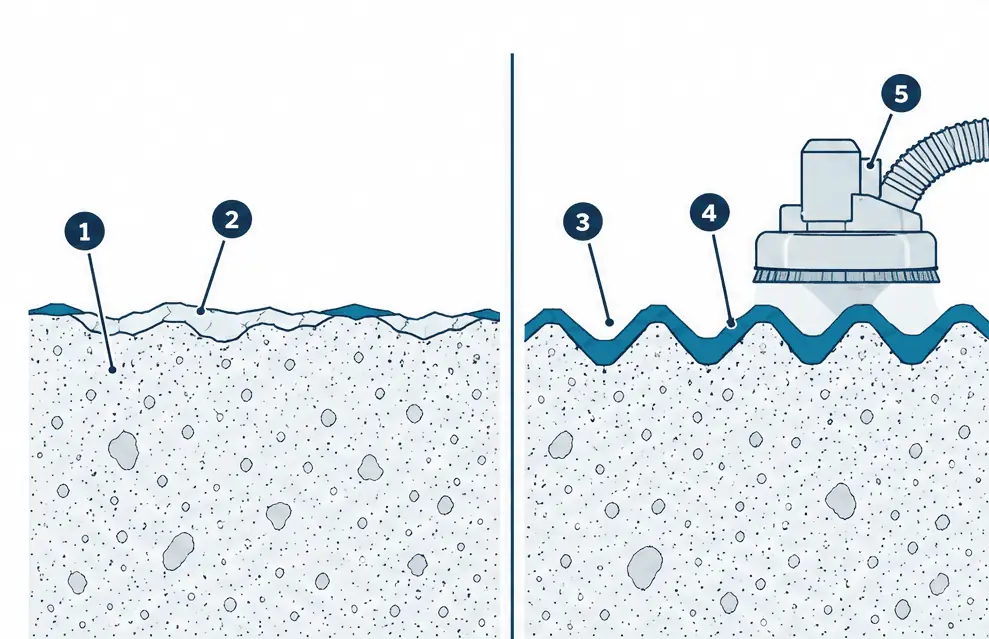
- Etching uses acid to dissolve cement paste. It leaves a light, uneven profile, does not lift a curing compound or an old coating, and produces rinse water to manage.
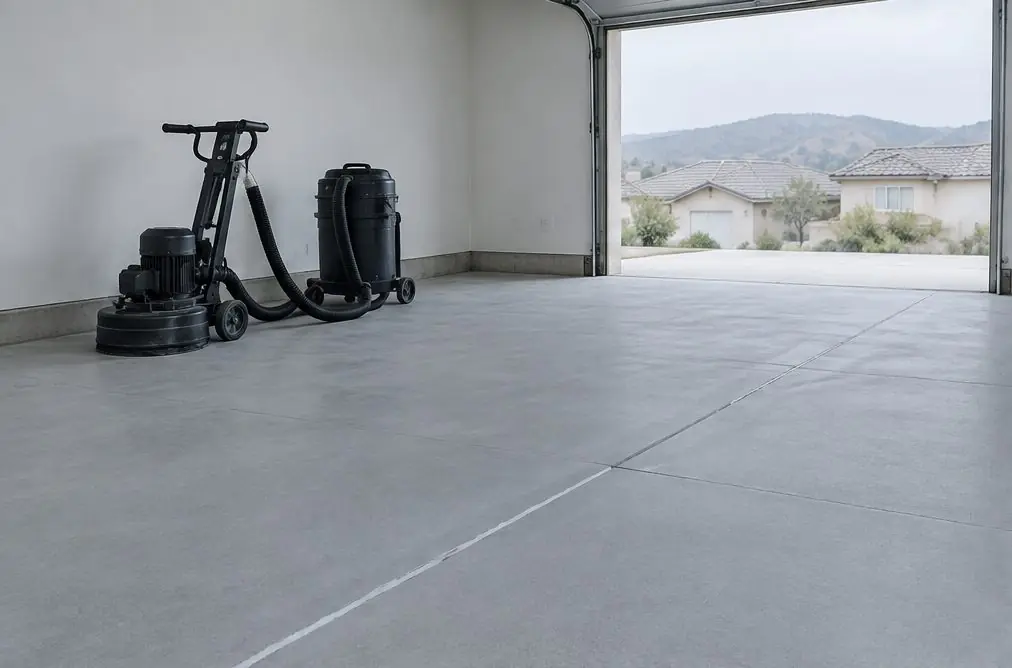
- Diamond grinding cuts the surface open with diamond tooling, removes compounds and thin coatings, and leaves a profile an installer can match to the data sheet. Dust goes to a shroud and vacuum.
Diamond grinding opens the surface so the coating can bond; acid etching is a weaker substitute. A bid that says only "etch" is worth a question, and a bid that says "grind" can name the profile it aims for.
What the numbers show
- Etched surface Acid leaves a shallow, uneven texture.
- Weak film Laitance or an old sealer can remain on top and release along with the coating.
- Ground surface A grinder cuts an even run of peaks and valleys.
- Coating in the profile The first coat fills the valleys and holds on the peaks.
- Shroud and hose A shroud and a vacuum hose keep grinding dust out of the air.
Three moisture tests for a slab
Curing and drying are different things, so a slab that is old enough can still read wet. Manufacturers commonly advise at least 28 days after a pour and up to 60 in some conditions.
| Test | Method | What it gives |
|---|---|---|
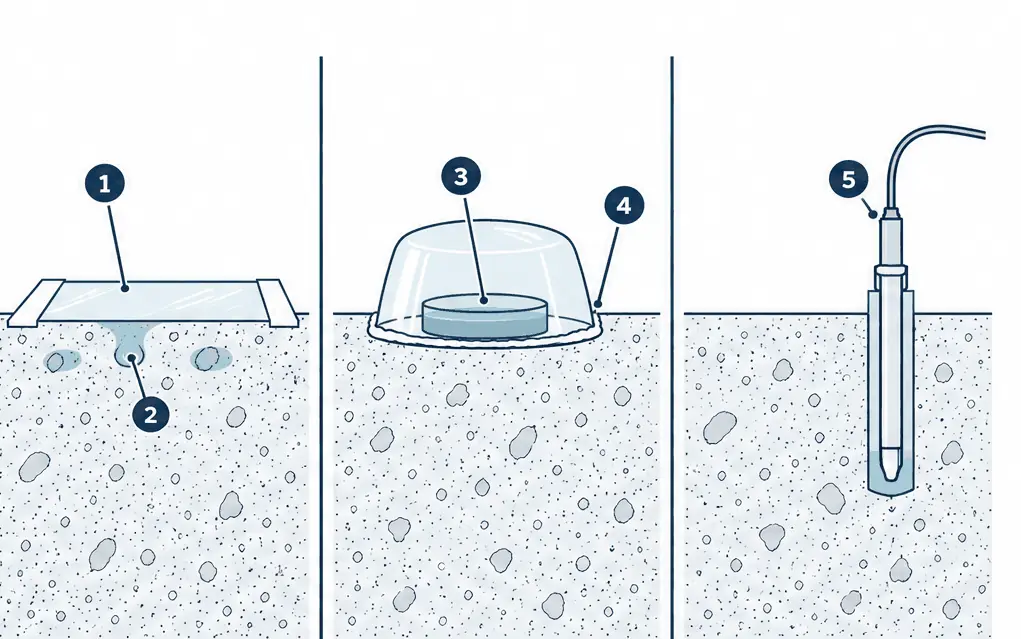
| Plastic sheet | A sheet taped to the slab for a day or so | A quick first look; condensation means vapor |
| Calcium chloride (ASTM F1869) | A sealed dish absorbs vapor for about three days | The rate vapor leaves the surface |
| In-slab humidity (ASTM F2170) | Probes set in drilled holes | The reading described as the most accurate |
The installed system sets the limit it tolerates. Where a reading is high, a moisture-mitigating primer is used or the job is reconsidered.
What the numbers show
- Taped plastic sheet A square of plastic sealed on all edges and left for a day or longer.
- Condensation Droplets under the sheet or a dark patch mean vapor is rising; a first look, not a reading.
- Calcium chloride dish A weighed dish under a sealed dome; the weight it gains measures vapor leaving the slab.
- Sealed dome rim The seal lets only the slab's own vapor reach the dish.
- In-slab probe A probe in a sleeve inside a drilled hole reads humidity inside the concrete.
Cracks, joints and chipped edges
| Defect | Typical repair | What to expect |
|---|---|---|
| Hairline shrinkage crack | Routed, filled, ground flush | Often stays closed |
| Sawed control joint | Cleaned and filled with a flexible filler | Moves with the slab |
| Chip, pit or small spall | Repair mortar, ground smooth | Hidden under flake, visible under solid color |
| Crack that has stepped or widened | Filled, and the movement watched | May show again through the coating |
Cracks are filled and ground flush; a moving crack can show again. A repair is a sound fix, not a promise that the line stays shut.
What prep adds to the price
Standard grinding is part of the base price. Minor cracks, pitting and small spalls add $1–$2 per square foot; extra crack or joint repair across many cracks is a flat $100–$300; a damp or heavily oiled slab adds $2–$4. Totals below are for flake epoxy ($6–$9 per sq ft on a sound slab):
| Garage | Cracks and pitting add | Flake total with cracks ($7–$11) |
|---|---|---|
| 1-car, 240 sq ft | $240–$480 | $1,680–$2,640 |
| 2-car, 400 sq ft | $400–$800 | $2,800–$4,400 |
| 3-car, 700 sq ft | $700–$1,400 | $4,900–$7,700 |
| 4-car, 900 sq ft | $900–$1,800 | $6,300–$9,900 |
A 400-square-foot garage with a damp or oily slab ($8–$13) comes to $3,200–$5,200; a moisture primer after a failed test adds $400–$1,000. Market estimates, not quotes.
Grinding dust and summer mornings
Grinding raises fine dust, so the shroud and vacuum run and the door stays open. In summer the grind is often a morning job, with the slab cleaned and checked before coating day. Some installers split prep and coating over two visits; a bid can say whether they share one.
Garage Floor Prep and Crack Repair — common questions
How do I know whether a new Murrieta slab is ready to coat?
Age is a start, since manufacturers commonly advise at least 28 days, and a moisture test is the decider. In-slab humidity probes are described as the most accurate, and the data sheet of the chosen system names the limit.
Does a builder sealer or curing compound have to come off?
Typically yes. A sealer on the surface can stop a coating from bonding, so it is ground off before priming.
Are hairline cracks in a 1990s slab a reason not to coat?
Usually not. They are a repair line: routed, filled and ground flush. A crack that keeps moving can show again, which is worth knowing before the color is chosen.
Garage Floor Prep and Crack Repair: check availability and price range
Bookings aren't open yet — a typical Murrieta range in about 30 seconds.