
Epoxy Garage Floors in Jefferson-Madison corridor, CA
Epoxy Floors Ridge Murrieta covers epoxy and commercial floors on the Jefferson-Madison corridor, the business-park district between Interstates 15 and 215, where light-industrial units, workshops and offices stand on new slabs with roll-up and dock doors.
Bookings aren't open yet. Leave your name and number; your message is recorded, and you'll get one message when a local installer is available.
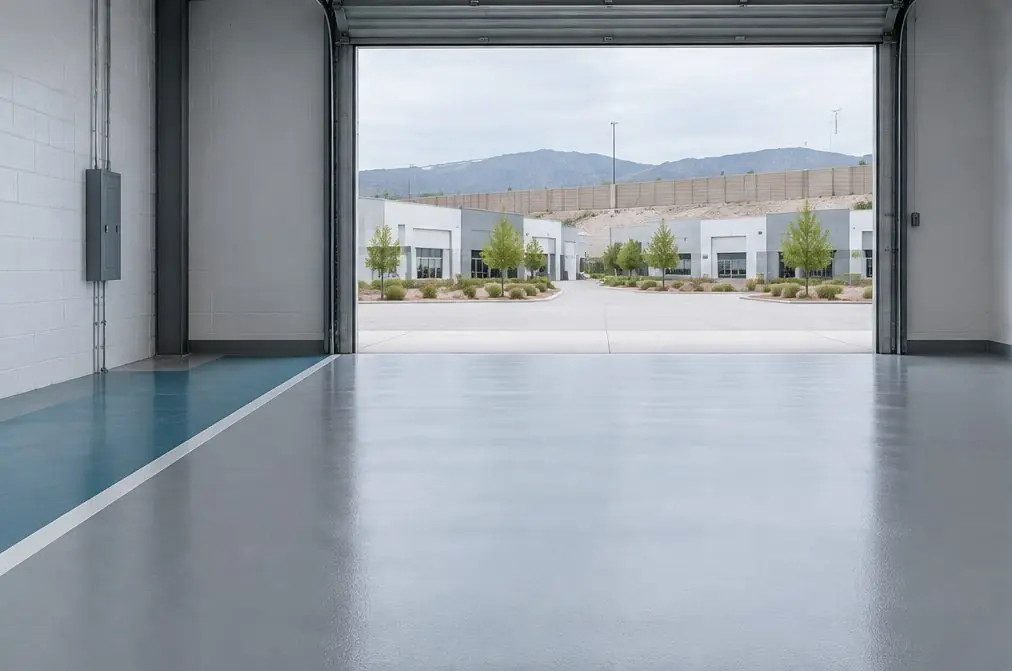
The city's business-park district
In an October 2025 news item the City of Murrieta says over 2 million square feet of business-park space is operating and about 10 million square feet is zoned for innovation and business parks across more than 220 acres on the Jefferson-Madison corridor. The city also reports about $16 million going into electricity, sewer and water for the area, a one-mile water pipeline along Jefferson Avenue, and vacancy of 3% for industrial space, 4% for business parks and 4.4% for offices. It lists direct access to I-15 and I-215. Most buildings here are young, which makes a floor-coating question mostly a new-slab question.
At a glance:
| Factor | What to expect on the Jefferson-Madison corridor |
|---|---|
| Buildings | Single-story business-park and light-industrial buildings, many multi-tenant |
| Businesses | Light manufacturing, assembly, storage, workshops, service units, offices |
| Floors | Slab-on-grade with saw-cut joints; curing compound on newer slabs |
| Approvals | The landlord or building owner for tenant changes; the county for a food facility |
| Typical systems | Solid color with grit for aisles, quartz where hard wheels turn, urethane cement for kitchens |
Garage and business floor coatings in Jefferson-Madison corridor
Corridor tenants and owners ask about:
Aisles that sweep clean and take striping
Solid color with grit costs $4–$8 per square foot in the estimator, and line striping adds $300–$1,000; paint goes on after the cure time on the data sheet.
Joints and chipped edges
A rigid coating bridges a saw cut badly, so the cuts are cleaned and filled with a flexible material, at $400–$1,200 for the joint filling line.
A new slab, not a worn one
A building a few years old has a curing compound to remove and a moisture reading to take; oil and damp add $2–$5 per square foot when the test calls for it.
Young slabs, big floors
New slab-on-grade buildings typically come with a curing compound that comes off before a coating goes down, and manufacturers commonly advise at least 28 days after the pour, up to 60 in some conditions; a moisture test decides. Large floors mean long working days, and with mean highs of 91°F in July and August a closed roll-up door traps heat, which shortens the working time of a fast-curing product. Crews favor early starts and open doors with fans when the data sheet allows.
Epoxy floors in Jefferson-Madison corridor: questions
Can a warehouse unit stay in use while its floor is coated?
Often, in phases. The dock lane stays open while other zones are ground and coated, and the order of moves is written before work starts. Return to foot traffic and forklifts is set by the product's data sheet, the temperature and the humidity.
Is a recently built business-park slab ready for a coating?
Not automatically. Manufacturers commonly advise at least 28 days, up to 60 in some conditions, and a moisture test decides. The curing compound from the build comes off first.
Check availability and prices in Jefferson-Madison corridor
Bookings aren't open yet — a typical Murrieta range in about 30 seconds.