
Worked case: a 1,600-square-foot four-bay auto repair shop in French Valley with oil-soaked slab and bay striping — what happens and what it costs
Epoxy Floors Ridge Murrieta walks through a typical job for a four-bay auto repair shop in a French Valley-style industrial building: a 1,600-square-foot slab soaked in oil near the lifts, degreased and ground, a solid-color epoxy with grit and the bays striped.
Bookings aren't open yet. Leave your name and number; your message is recorded, and you'll get one message when a local installer is available.
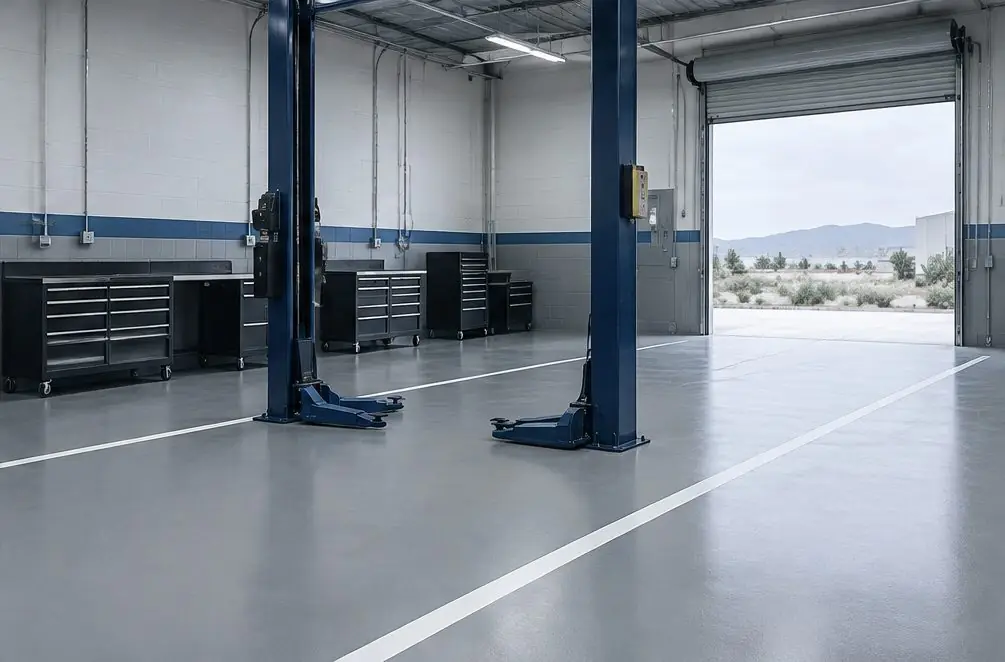
Worked example. The pictures are AI concept illustrations, not photographs; no installation was performed or arranged through this site; prices are typical Murrieta area market ranges, not quotes.
 Illustration
Project Examples & Typical Prices
The scenario
Picture a repair shop in a light-industrial building near French Valley Airport, four bays of about 1,600 square feet in all. Two bays have a two-post lift. The slab is dark with oil around each lift and under the tire changer, and the shop floor dusts near the roll-up doors. The shop cannot close for a week; it works two bays while the other two are coated.
The owner wants the floor to be easier to clean and to show bay lines, and asks whether oil already in the concrete matters. It does: the slab is degreased and ground, and a patch test shows whether oil keeps coming up.
The starting conditions at a glance:
- Size: about 1,600 square feet, four bays
- Slab: oil-soaked near the lifts, dusty near the doors
- System: solid-color epoxy with grit in the top coat
- Schedule: phased, two bays at a time
What the job involves
- The shop chooses which two bays go first and shifts lifts, jacks and tool carts into the other pair.
- Grinding takes off the surface; oil spots are degreased, ground a second time and tested with a small patch to see whether oil keeps rising.
- Cracks and chipped saw-cut edges are repaired, and the lift base plates are masked off.
- Primer and pigmented epoxy go down in the first pair of bays, followed by a clear coat with fine grit.
- Once the first pair has cured per the data sheet, the crew moves to the second pair.
- Bay lines and walkways are striped after the final cure.
Materials and prep
- A planetary grinder with a heavy-duty extractor
- Degreaser, repair mortar and crack filler for the lift areas
- Primer, a pigmented epoxy and a clear coat carrying fine grit
- Line paint or tape, a chalk reel, spiked shoes and fans for the open bay doors
What it typically costs in the Murrieta area
| Solid-color epoxy with grit, 1,600 square feet installed ($4–$8 per sq ft) | $6,400–$12,800 |
| Oil-soaked or damp slab (+$2–$5 per sq ft) | +$3,200–$8,000 |
| Line striping and safety markings | +$300–$1,000 |
| Typical total | $9,900–$21,800 (market range, not a quote) |
These are typical local ranges, not a quote or an offer; an installer prices the actual job after seeing the floor.
Add-ons often paired with this job
- Joint filling (saw cuts and control joints) — +$400–$1,200. Saw cuts between bays can be filled with a flexible material.
Why it is done this way
Solid color with grit at $4–$8 per square foot is the typical choice for bays: it cleans easily, takes striping and does not hide oil but does shed it. The oil-and-damp line of $2–$5 per square foot covers degreasing, extra grinding passes and, where a test calls for it, a primer, so the combined range is $6–$13 per square foot.
Hot tires and hydraulic fluid are the shop's enemies, so the top coat and its prep matter more than the color. Hot-tire pickup is mostly a prep and product problem; a ground slab and a system rated for it reduce the risk.
The striping is a flat $300–$1,000 and gives the shop its bay lines, a walkway and a parts-staging area.
The alternatives that were weighed and set aside:
- Quartz broadcast at $8–$15 gives more texture for wet areas.
- A penetrating sealer costs less and wears faster under tires.
What would change the price
- Oil that keeps rising through the test patch means more grinding, a primer or a different plan.
- Removing a lift or filling a pit is building work, outside the coating.
- More cracks bring in the repair line of $1–$3 per square foot.
- Lifts and cabinets that cannot move stretch the schedule.
- Stripe work beyond bay lines is a flat item.
Where this leads
- Service page: Auto Shop Floor Coating — Bay-by-bay choices for repair shops, with lift-pad cautions, fluid exposure and a three-bay sample budget.
- Local page: Epoxy garage floors in French Valley
- All services and typical prices: epoxy garage floors in Murrieta
- More worked examples: Project Examples & Typical Prices
Check availability and the price range for this setup
Bookings aren't open yet — a typical Murrieta range in about 30 seconds.