
Worked case: a 1,200-square-foot restaurant kitchen floor in urethane cement with a coved base in a downtown storefront — what happens and what it costs
Epoxy Floors Ridge Murrieta walks through a typical job for a 1,200-square-foot restaurant kitchen in an Old Town Murrieta-style storefront: a urethane cement floor with an integral coved base for a kitchen that is washed down with hot water, scheduled in phases and mindful of the county's plan check.
Bookings aren't open yet. Leave your name and number; your message is recorded, and you'll get one message when a local installer is available.
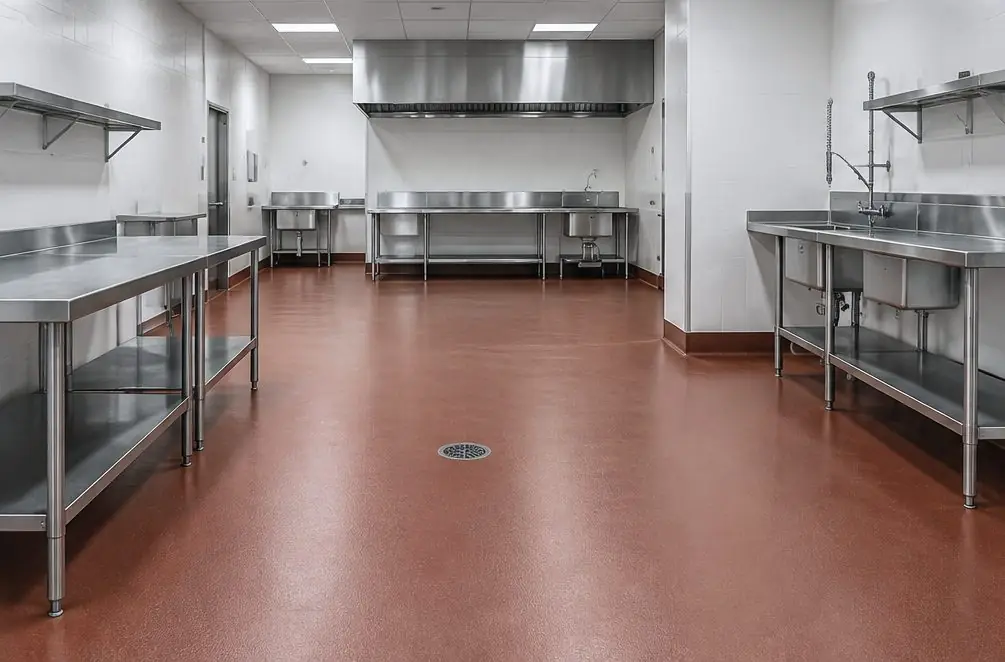
Worked example. The pictures are AI concept illustrations, not photographs; no installation was performed or arranged through this site; prices are typical Murrieta area market ranges, not quotes.
 Illustration
Project Examples & Typical Prices
The scenario
Picture a restaurant in a historic downtown storefront, with a kitchen and prep area of about 1,200 square feet behind a dining room. The kitchen has a quarry-tile floor with failing grout, a floor drain and a hot-water washdown each night. The tile lifts at one door, and the grout has worn away in the cook line.
The owner wants a floor that is seamless, tolerates hot-water washdowns and curves up the wall as a coved base. The restaurant cannot close for a week, so the work is planned in phases: the prep area one weekend, the cook line the next. The owner also asks what the county needs, because the change is to a floor in a licensed food facility.
The starting conditions at a glance:
- Size: about 1,200 square feet of kitchen and prep floor
- Slab: concrete with old quarry tile and grout, one drain, one lifting door threshold
- System: urethane cement with an integral coved base, about 100 linear feet
- Schedule: phased over two weekends, with the dining room open between
What the job involves
- The owner asks the Riverside County Department of Environmental Health about its plan check for a floor change; typically a finish schedule listing the floor and base material is part of what the county reviews, and the department decides what applies.
- The tile is removed in zones, the slab is ground and checked for moisture, and the drain area is protected.
- A primer and a troweled urethane cement mortar go down in the first zone, with the cove formed up the wall at the same time.
- The second weekend repeats the steps for the cook line, with the cove joined to the first zone's cove.
- Ventilation is planned around the staff who return; the data sheet sets the day for foot traffic, carts and hot-water washdowns.
- The owner keeps the product data sheet and the finish schedule on file.
Materials and prep
- Tile removal tools, floor grinder with diamond segments and a dust extractor
- Urethane cement kit (primer, mortar and sealer) and a trowel with a cove tool
- Moisture test kit, ventilation fans and drain protection
What it typically costs in the Murrieta area
| Urethane cement (heat and washdown areas), 1,200 square feet installed ($10–$18 per sq ft) | $12,000–$21,600 |
| Cove base up to 100 linear feet | +$1,500–$2,500 |
| Typical total | $13,500–$24,100 (market range, not a quote) |
These are typical local ranges, not a quote or an offer; an installer prices the actual job after seeing the floor.
Add-ons often paired with this job
- Line striping and safety markings — +$300–$1,000. Not typical for a kitchen, but a safety line at a walk-in door is possible.
Why it is done this way
Urethane cement is the system many installers name for kitchens with hot-water washdowns, because it tolerates heat and thermal shock better than standard epoxy. At $10–$18 per square foot it is the most expensive of the four commercial systems, and 1,200 square feet carries $12,000–$21,600 on its own.
The cove is a flat $1,500–$2,500 for about 100 linear feet. It is the line that connects the floor to the wall without a seam, and it is the one a county reviewer looks for when the finish schedule says the base is coved.
Phasing is what lets the restaurant keep serving. In the estimator, schedule is a note for the contractor and does not change the range; the real quote prices the extra mobilization of two weekends.
The alternatives that were weighed and set aside:
- A standard epoxy at $4–$8 would cost less but is generally less tolerant of hot washdowns.
- Replacing the tile keeps the grout lines, which a coated floor does not have.
What would change the price
- Tile that cannot be lifted without breaking the slab adds repair time.
- A damp slab adds the moisture line of $2–$5 per square foot.
- More than 100 linear feet of cove raises the flat cove line.
- Drains, slopes and grease interceptors are plumbing and building work and are not part of the coating.
- A fully closed kitchen shortens the schedule and may lower the mobilization cost.
Where this leads
- Service page: Commercial Kitchen Flooring — Urethane cement and epoxy for kitchens and food areas, coved bases and the county plan check explained.
- Local page: Epoxy garage floors in Old Town Murrieta
- All services and typical prices: epoxy garage floors in Murrieta
- More worked examples: Project Examples & Typical Prices
Check availability and the price range for this setup
Bookings aren't open yet — a typical Murrieta range in about 30 seconds.