
Testing a Garage Slab for Moisture: Plastic Sheet, Calcium Chloride and Probes
Epoxy Floors Ridge Murrieta explains why the newest garage slabs in Murrieta can be old enough on the calendar and still too wet for a coating, describes the plastic sheet, calcium chloride and in-slab probe tests, and shows how to read the result.
Bookings aren't open yet. Leave your name and number; your message is recorded, and you'll get one message when a local installer is available.
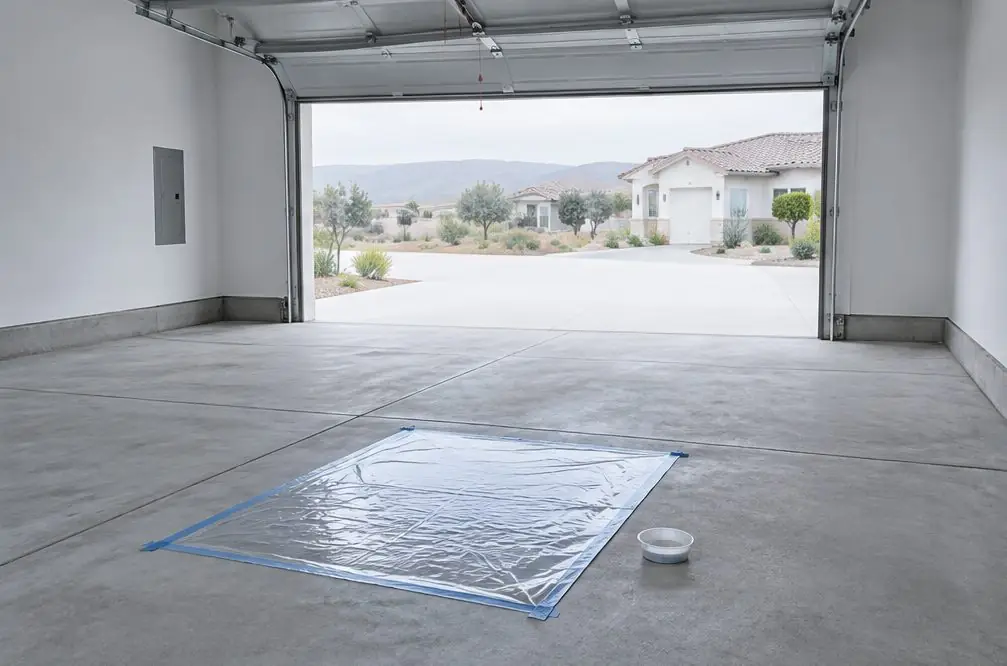
The floor as it starts
 Illustration
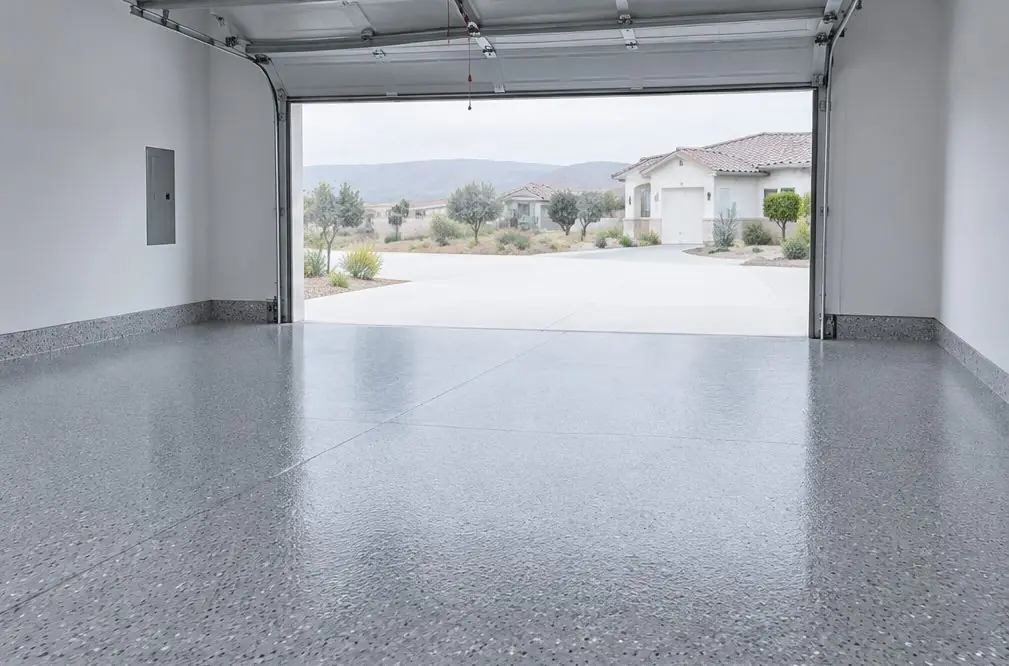
The finished floor (illustration)
 Illustration
A slab can be old enough and still be wet
Coating makers commonly advise waiting at least 28 days after a pour, and up to 60 in some conditions. The same advice adds that a moisture test decides. In a city whose newest streets are still being finished, the first owner may start thinking about a floor when the slab is only months old, and concrete can have strength long before it has dried out.
The acceptable level is set by the specific primer or base coat, so the installer looks it up in that product's data sheet.
The plastic sheet, the dish and the probe
Plastic sheet. A clear square is taped to the floor for roughly a day. Condensation underneath or a darkened patch is a warning. It is cheap, but it gives a yes or a no and no number.
Calcium chloride dish (ASTM F1869). A weighed dish of calcium chloride sits under a sealed dome for several days and is weighed again. The gain converts to a vapor emission rate. It samples the top of the slab, and room conditions affect it.
In-slab humidity probes (ASTM F2170). Small holes are drilled, sleeves and sensors are set and given time to settle, then humidity is read. Of the three, this one is widely described as the most accurate, which is why new concrete usually gets probes.
Murrieta's temperature swing
January lows average 41°F; July and August highs average 91°F. A garage sees much of that range, and the readings follow it.
A cold, damp slab dries slowly, and a closed garage dries slower than a ventilated one. A slab baking on a summer afternoon dries faster but raises another problem, since a hot floor at mixing time shortens working time and invites bubbles. Probes are placed where the coating will go, not only at the middle of the floor but near the door and along any wall that shares a planter or a downspout.
The film a builder leaves behind
Many builders spray a curing compound on fresh concrete. That film can outlast the move-in and stop a coating from gripping. A few drops of water give a hint, because they bead on a sealed surface and soak into bare concrete. Only grinding removes it.
On a newer home, then, two answers belong in writing: which moisture test, and how the sealer is handled.
When the number comes back high
A high reading starts a conversation rather than ending the job. The options are to wait and retest while the garage is ventilated, to lay a moisture-mitigating primer rated for the measured level (a flat option of $400–$1,000 in the estimator, or part of the $2–$4 per square foot damp-slab surcharge), to choose a system that tolerates more moisture, or to look for the source. A slab that is wet from a drainage or plumbing leak needs the leak fixed first, and that is building work, not coating.
Coatings laid over rising vapor can blister or peel later, which is why a number beats a guess. The questions for a bid are short: which test, where, which reading changes the plan, and does the price move if the reading is high.
Where this leads
- Service page: Garage Floor Prep and Crack Repair — Grinding, repair and moisture testing by slab age, the part of the job that decides whether a coating stays down.
- All services and typical prices: epoxy garage floors in Murrieta
- More illustrated guides: Epoxy Floor Guides
Check availability and the price range for this setup
Bookings aren't open yet — a typical Murrieta range in about 30 seconds.